





Short answer: On intact skin, the realistic PDRN benefits are better hydration, a calmer look on red or reactive skin, and more comfort for skin that is dry, mature, recovering or worn down by retinoids. The evidence for creams is early and small. PDRN will not fade dark spots, fill deep wrinkles or lift sagging skin.
We make a PDRN cream, so read this as a guide from the people who formulated one rather than a neutral review. The question we hear most is whether PDRN is worth using on a particular kind of skin, so this guide answers concern by concern, including where our honest answer is no.
Which skin concerns can PDRN help with?
First, the one-paragraph version of the ingredient. PDRN (polydeoxyribonucleotide) is DNA taken from salmon or trout milt, cut into fragments and purified until the proteins are gone; on an ingredient list it appears as sodium DNA. It started out as an injectable tissue-repair drug in Italy before Korean clinics turned it into a skin booster. The full background, including why an injection and a jar are two very different things, is in our explainer on what PDRN is in skincare.

For this guide, one practical fact shapes everything. PDRN fragments are large. Healthy skin keeps most big molecules out, so a PDRN cream does most of its work in the upper layers, where it holds on to water and, based on lab and injection research, appears to have a calming effect. That is why the concerns it suits best are surface concerns: dryness, tightness, redness and a stressed barrier.
| Skin concern | Realistic benefit | Evidence strength | How to use it |
|---|---|---|---|
| Dry, dehydrated skin | Softer, less tight skin from the first application | Fair: it behaves like other water-binding ingredients | Twice daily on damp skin, sealed in with a cream |
| Red, reactive skin | A calmer look over a few weeks | Early: anti-inflammatory signals in lab and injection studies | Short, fragrance-free routine after a patch test |
| Skin irritated by retinoids | Fewer flaky, stinging evenings | Indirect: based on hydration and good tolerability | As the buffer layer on retinoid nights |
| Mature and menopausal skin | More supple feel, fine dryness lines look softer | Early: one short topical trial so far | Nightly, next to sunscreen and a retinoid |
| Recovering barrier, after a procedure | Comfort while skin rebuilds | Indirect: strong wound data, but for injections | Only once your practitioner clears topical products |
| Dark spots, deep wrinkles, sagging | Nothing specific | Weak or absent for creams | Choose proven actives or in-clinic options |
PDRN for dry and dehydrated skin
What it may do. The most dependable benefit, and the first you notice. Dry skin lacks oil; dehydrated skin lacks water, and many people over forty have both. PDRN is a strong humectant: it attracts water and holds it in the outer layer of skin, so the surface feels smoother and less tight within minutes.
Evidence, in one line. Fair, but not special to PDRN: hyaluronic acid and glycerin do similar surface work, so the hydration is real without being unique.
How we would use it. Apply to skin that is still slightly damp after cleansing, because a humectant needs water nearby to hold. On very dry skin it works best inside a cream with oils or ceramides that slow the water from leaving again.
PDRN for red, reactive skin
What it may do. In lab and animal research, PDRN switches on a receptor on cells (the adenosine A2A receptor) that dampens inflammatory signalling. On a face, the hoped-for result is simple: skin that flushes less easily and looks more even in color after a few weeks of steady use.
Evidence, in one line. Early: the calming mechanism is well described for injected PDRN, while data for creams on reactive facial skin are close to nonexistent.
How we would use it. With reactive skin, the rest of the formula matters as much as the headline ingredient. Choose a short ingredient list, skip fragrance if it bothers you, and try it on a small patch of forearm skin for a few nights first. If you have a fish allergy, speak to your allergist before trying any salmon-derived product.
PDRN for skin that is irritated by retinoids
What it may do. Retinoids are among the best-documented anti-aging ingredients, and irritation is also one of the main reasons people stop using them. PDRN is not an acid, not an exfoliant and not a retinoid, so it adds very little extra stress. As a hydrating layer, it can make the peeling, tight weeks of a retinoid easier to get through.
Evidence, in one line. Indirect: nobody has tested PDRN as a retinoid buffer, but its tolerability across published studies has been good.
How we would use it. Keep the retinoid, and let the PDRN product support it rather than replace it. The exact order, spacing and what to do on rough nights are in our guide on how to use PDRN with retinol, and the comparison of the two ingredients is in peptides vs retinol.
PDRN for mature skin

What it may do. As estrogen falls, skin tends to become thinner, drier and slower to recover, and many women notice more reactivity in their fifties than they ever had before. PDRN fits that picture well: it hydrates, it is gentle, and it can make a routine with a retinoid feel less harsh. In one small split-face study published in 2026, a 0.1 percent PDRN eye cream did better on measured wrinkles than a retinol cream over a few weeks.
Evidence, in one line. Early: one brief trial, partly run by people employed in the cosmetics industry, and nobody has replicated it yet.
How we would use it. As the last step at night, not as the whole strategy. Daily broad-spectrum sunscreen and a retinoid remain the backbone of anti-aging care for the American Academy of Dermatology, and PDRN sits comfortably next to both. We have written about what changes in skin during menopause in menopause skin changes and put together a full skincare routine over 50.
PDRN after a procedure or on a damaged barrier
What it may do. PDRN's strongest science lives here, and so does the widest gap to a jar. In a 2014 trial in people with diabetic foot ulcers, wounds injected with PDRN healed more often than those given a placebo. That is why Korean clinics like it for recovery after lasers and needling. On skin that is over-exfoliated or tight and stinging, a PDRN cream can offer a soft, comfortable layer while the barrier repairs itself.
Evidence, in one line. Indirect for creams: the wound results come from injections into damaged tissue, not from a moisturizer on a sensitized face.
How we would use it. After any in-clinic treatment, follow your practitioner's aftercare and add new products only once they say the skin is closed. For an everyday stressed barrier, pause exfoliating acids and scrubs, keep the routine to cleanser, PDRN product and sunscreen for a couple of weeks, and watch whether the stinging settles. Our checklist of damaged skin barrier signs helps you tell a stressed barrier from a true skin condition.
Where PDRN will not help
Three concerns come up often, and for each one PDRN is the wrong tool to lead with.
- Pigment and dark spots. The main study on PDRN and pigment was done in animals, combined PDRN with vitamin C and niacinamide, and used microneedling to get it in. For spots on human faces, daily sunscreen plus vitamin C, niacinamide or a retinoid has much better support.
- Deep wrinkles. Lines that are still there when your skin is rested and well hydrated sit in the dermis. A cream can make them look a little softer by smoothing the surface around them; it cannot fill them.
- Sagging and loss of volume. These come from changes in fat, bone and the deeper support of the face. No topical ingredient lifts them, and a label that suggests otherwise is overpromising. In-clinic options are the honest route here.
How to get the most out of a PDRN product
- Try a small area first. A few nights on the forearm before the face, especially with reactive skin.
- Apply to damp skin. Right after cleansing, or over a watery toner, so the humectant has something to bind.
- Put it in the right place. Thinner textures before thicker ones; a cream usually goes last at night and before sunscreen in the morning. Our skincare layering order covers the details.
- Keep your proven basics. Sunscreen every morning, and a retinoid if your skin tolerates one.
- Judge it after two to three months. Snap a before picture by the same window at the same time of day, then repeat. No change in comfort or texture means a simpler moisturizer may do the job.

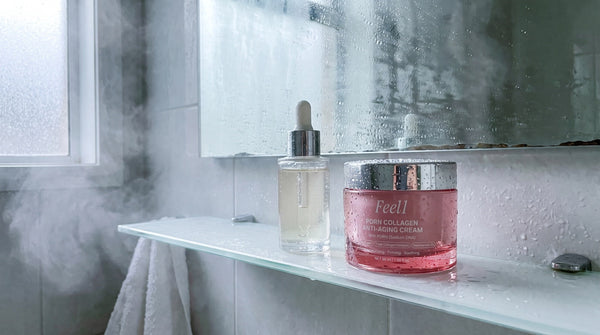
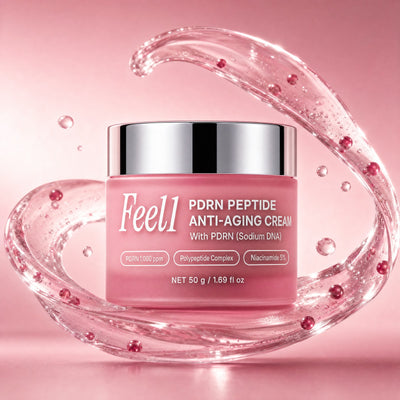
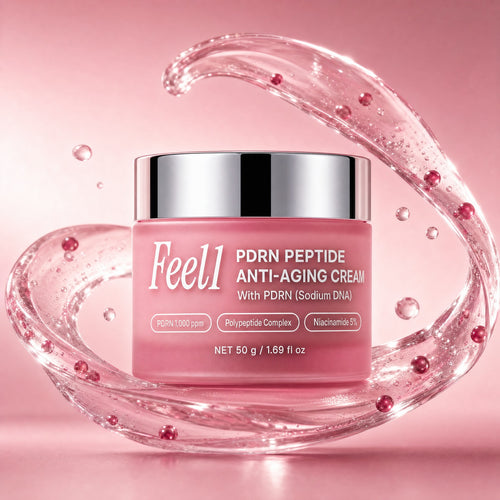
We built our own cream around the concerns in the first half of this guide. It declares its PDRN content on the label, 1,000 ppm of salmon-derived sodium DNA, which is 0.1 percent. That is a modest amount, and we say so openly. It also carries 5 percent niacinamide, which has better human data for uneven tone than PDRN does, in a pink gel-cream meant to be the final layer.
This guide is general information about a cosmetic ingredient and not medical advice. See a dermatologist about skin problems that persist, and an allergist before using fish-derived products if you have a fish allergy.
Sources
- Squadrito et al., Pharmacological Activity and Clinical Use of PDRN, Frontiers in Pharmacology (2017): pmc.ncbi.nlm.nih.gov/articles/PMC5405115
- Squadrito et al., PDRN and the healing of chronic diabetic foot ulcers: results of a clinical trial, J Clin Endocrinol Metab (2014): pubmed.ncbi.nlm.nih.gov/24483158
- Bos and Meinardi, The 500 Dalton rule for the skin penetration of chemical compounds and drugs, Exp Dermatol (2000): pubmed.ncbi.nlm.nih.gov/10839713
- Ye et al., Topical medium-length PDRN and dermal extracellular matrix repair in photodamaged skin, PLoS One (2026): pmc.ncbi.nlm.nih.gov/articles/PMC13353946
- American Academy of Dermatology, How to select anti-aging skin care products: aad.org
Frequently asked
Is PDRN good for acne-prone skin?
PDRN is not an acne treatment and has no published acne data, but it is not known as a pore-clogging ingredient and may calm skin that is sore from acne medication. Choose a light, oil-free texture, keep your proven acne actives such as benzoyl peroxide or adapalene, and let PDRN play the supporting hydration role.
Can you use PDRN every day?
Yes. PDRN hydrates and soothes; it does not peel or resurface, so you can start at full frequency without easing in or skipping nights. Most people use it morning and night. Start with evenings for the first week on reactive skin, then add mornings under sunscreen if everything stays comfortable.
Does PDRN help with dark spots?
Not in any way you can count on. The pigment research on PDRN is mostly in animals and combined with other ingredients and microneedling. If spots are your main concern, look for niacinamide, vitamin C or a retinoid, and use broad-spectrum sunscreen every day, which does more for dark spots than any cream.
Is PDRN better in a cream or a serum?
Neither format is better across the board; it depends on your skin. A serum layers easily and suits oily or combination skin under a light moisturizer. A cream adds a sealing layer that dry and mature skin usually needs. We compare both in detail in PDRN serum vs PDRN cream.