




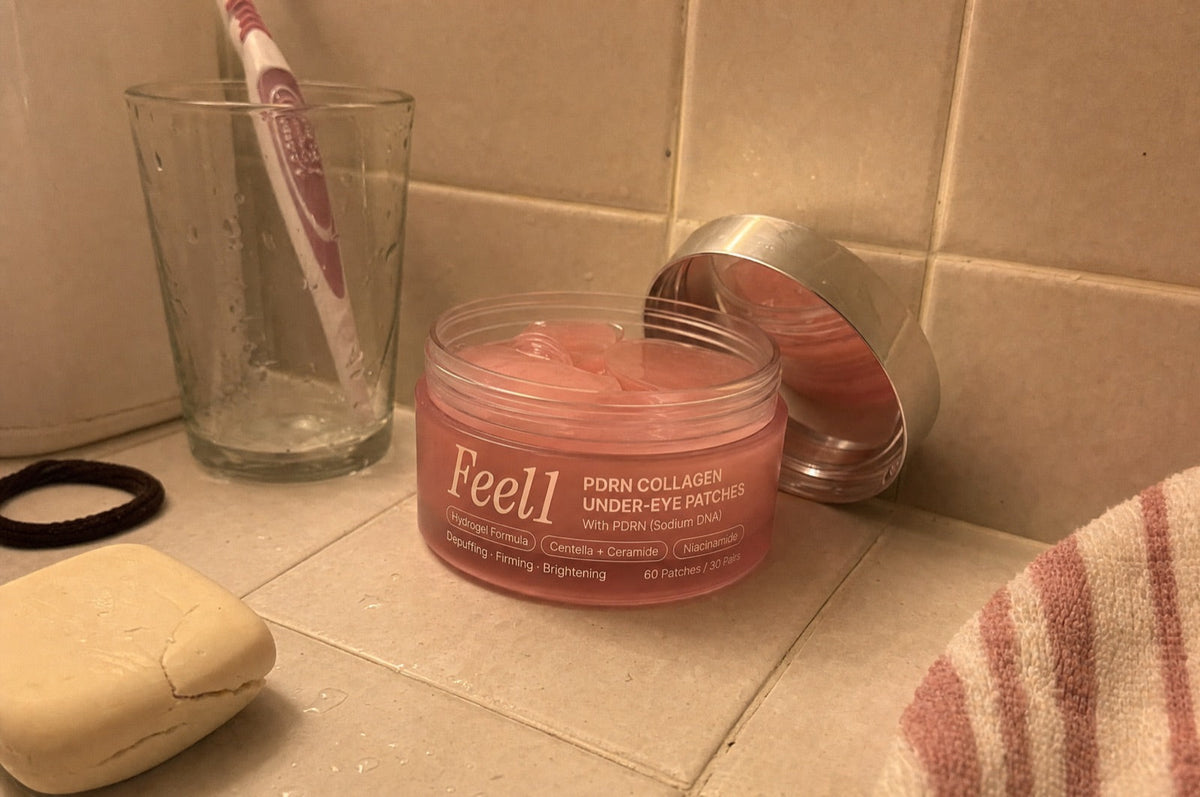
Short answer: PDRN eye patches are hydrogel under-eye patches whose essence contains polydeoxyribonucleotide — purified salmon DNA fragments, listed as Sodium DNA on the label. The gel holds that active against the thinnest skin on the face for twenty minutes, which is longer contact than any cream manages. They hydrate, calm and visibly de-puff; they do not erase set wrinkles.
We make one of these, so this is not a neutral review. It is the explanation we wish we had read before we formulated ours: what the ingredient is, what the patch format changes, how it differs from collagen, caffeine and gold patches, and where twenty minutes stops.
What is PDRN in eye patches?
PDRN stands for polydeoxyribonucleotide: short DNA fragments, extracted from salmon milt or roe, then purified until almost no protein is left. That purification is the part that matters. DNA is chemically the same across species, so a purified fragment is a purified fragment whether it came from a fish or not. The salmon part is a sourcing detail, not a magic property.
The ingredient arrived in skincare through Korean clinics, where it is injected as a polynucleotide treatment. The molecule, the mechanisms proposed for it and the injectable-versus-topical difference are written up in what PDRN is in skincare. For a patch, the short version is enough: PDRN is strongly water-binding, it is soothing on reactive skin, and in cosmetic concentrations it works at the surface and in the upper layers — not in the dermis, where the injectable goes.

What a hydrogel patch does that a cream cannot
The active is the same molecule in a cream or a patch. What changes is how long it stays where you put it.
Contact time
A cream is absorbed or evaporated within a couple of minutes. A hydrogel patch keeps a wet layer of essence pressed against the skin for the whole fifteen to twenty minutes it is on. For a large, water-loving molecule like PDRN, that sustained contact is the difference between a fleeting visit and an actual dwell time.
Occlusion
The gel also forms a seal. Under it, water cannot evaporate, the outer layer of skin softens slightly, and the essence has nowhere to go but in. It is the same reason a mask outperforms the same formula worn open, and why the under-eye — thin, dry, almost no oil glands — responds so visibly to twenty minutes of it. We cover the mechanics and the limits in do under-eye patches work.
Cold and weight
A gel patch has mass. From the fridge it is cool and slightly heavy, and both move the fluid that collects under the eye overnight. A cream can carry a cooling ingredient; it cannot carry cold. None of this makes a patch better than a cream in general — only better at one job, a defined window of concentrated contact. We have set the two against each other in eye patches vs eye cream.
PDRN patches vs collagen patches: what is the difference?
Most under-eye patches fall into four families, named after the headline ingredient. The gel and the format are usually the same; what differs is what the essence is built around.
| Patch type | Headline active | What it plausibly does in 20 minutes | What the name promises that it cannot do |
|---|---|---|---|
| PDRN | Sodium DNA (salmon-derived) | Hydrates, calms, supports the look of the surface over weeks of use | Replace an injectable polynucleotide treatment |
| Collagen | Hydrolyzed or soluble collagen | Binds water at the surface, smooths dehydration lines for hours | Add collagen to the skin — the molecule is far too large to get in |
| Caffeine | Caffeine | Constricts surface vessels, helps fluid move, quickest for puffiness | Anything lasting; the effect is hours, not days |
| Gold | Colloidal gold, usually with collagen | Whatever the rest of the formula does; the gold is largely visual | Anything specific to the gold |
Collagen patches
Collagen on a label is almost always hydrolyzed collagen, a good humectant: it draws water to the surface and holds it there, which is what makes a dehydrated under-eye look smoother after twenty minutes. It does not become part of your skin — the molecules, even chopped up, are far too large to cross the barrier. A collagen patch is a hydration patch with a more expensive-sounding name. Ours contain soluble and hydrolyzed collagen for exactly that humectant reason, listed after the PDRN.
Caffeine patches
Caffeine has the clearest short-term effect on puffiness: it narrows the small surface vessels and encourages fluid to drain. If your only complaint is a swollen morning under-eye, it is a fair choice. It does nothing for dryness, and its effect ends when the caffeine does.
Gold patches
Mostly collagen patches with a colourant. There is no convincing evidence that colloidal gold does anything the gel around it does not already do. Judge them on the ingredient list.
PDRN patches
PDRN sits between the camps. It is a strong humectant like collagen, so it hydrates on the day; it is soothing, so reactive under-eyes tolerate it well; and unlike caffeine, the argument for it is cumulative — regular contact over weeks rather than a one-off drain. That argument rests on cell and wound-healing research; the evidence that a cosmetic patch reproduces it in the under-eye is thin. What we can stand behind is what we saw: better hydration, a calmer surface, a visibly de-puffed under-eye after twenty minutes.

How to read the ingredient list
The front of the pack tells you what the brand wants you to notice. The back tells you what is in it, by weight. Three things to look for:
- Find "Sodium DNA". That is the INCI name for PDRN. If it is not there, the patch does not contain PDRN, however the front is worded. "Polynucleotide" or "PN" are related but not the same declaration.
- Note where it sits. Ingredients are listed by weight. On our own patches the order is allantoin, licorice, niacinamide, then Sodium DNA in fourth place, then ceramide NP, collagen, centella and hyaluronic acid. Fourth is a real position. If Sodium DNA appears after the preservatives, it is there for the label.
- Look at what surrounds it. Niacinamide, ceramides, centella and hyaluronic acid all have better-documented topical evidence than PDRN itself, and a PDRN patch that carries them is doing much of its work through them. That is how we built ours.
Some brands quote a purity figure for their PDRN. Ours states 99 percent — the supplier's specification, not our own measurement, and any brand's number should be read the same way.
Do PDRN eye patches work for wrinkles?
It depends on which wrinkles.
Dehydration lines — the fine crepey creases that appear in the afternoon and vanish after a good night's sleep — respond within one session. Twenty minutes of occlusive hydration plumps them for several hours. This is the effect people photograph and the effect that makes concealer sit properly.
Set expression lines — the ones still there when you are rested and hydrated — do not respond to a patch. They are structural, below the surface, and a cosmetic patch does not reach them. Over weeks we saw the area look smoother, which softens how a line reads; we did not see a line disappear, and we would not trust a brand that says it did.
Hollows and pigmentation are not wrinkles, but they are what many people mean by "dark circles", and neither responds to hydration. If you are not sure which you have, dark circles, hollows or puffiness has a two-minute mirror test.

What twenty minutes can and cannot do
Reliably, on the day: a more hydrated, smoother under-eye; visibly less morning puffiness, especially from the fridge; concealer that applies evenly. Hours, not days.
Plausibly, over weeks: a more even-looking surface, less morning tightness, dehydration lines that arrive later in the day. These are the changes we noticed on our own team, and the changes a good niacinamide-ceramide-humectant formula would be expected to make. We cannot separate the PDRN's share from the rest, and neither can anyone else without a controlled study.
Not at all: structural change, permanent lift, pigment fading, filling a hollow. A patch is a maintenance tool, not a treatment course, and the name on the jar does not change that.
How we tested ours
Before launch we ran the patches on our own team: six people, ages forty-three to sixty-eight, four weeks, three mornings a week, phone photos at the same window. Not a clinical trial. What we learned changed the product.
- The fridge is not optional. At room temperature the de-puffing was modest and inconsistent. Chilled, it was the thing everyone commented on.
- The jar beat the sachet. An early version came in foil sachets: tidy, expensive, and drier than patches sitting in a shared essence. We moved to a jar of thirty pairs.
- Twenty minutes, not forty. Left longer, the gel dries and the under-eye feels tighter afterwards than before. Use a timer.
- One person reacted. Mild redness after the first use, gone by morning, never repeated. It is why we suggest a forearm test for reactive skin.
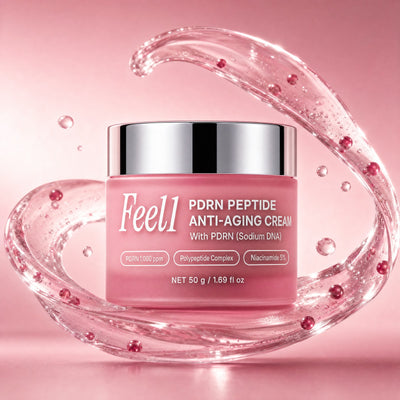
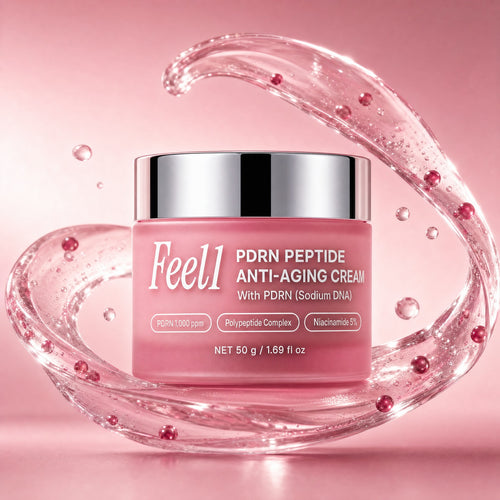
The jar costs $29.99, about one dollar a pair. The PDRN Capsule Cream, at $34.99, carries the same active in a daily format; the two are built to overlap, not compete.
Frequently asked
Is PDRN in eye patches the same as a salmon DNA facial?
Same ingredient family, different delivery. A clinic treatment injects polynucleotides into the dermis with a needle. A patch holds purified PDRN against the surface for twenty minutes. The patch hydrates, calms and visibly de-puffs; it does not reproduce what an injectable does, and no topical can.
Are PDRN eye patches safe for sensitive skin?
Purified PDRN is generally well tolerated and soothing, and our formula surrounds it with allantoin, licorice and centella for that reason. Reactions are usually to something else in the essence. Test a patch on the inner forearm for two days first, and stop if you see redness that does not settle overnight.
How often should I use PDRN eye patches?
Two or three mornings a week is enough to maintain the effect, and the pattern we tested. Daily is fine if the skin stays comfortable, but there is no evidence that more sessions build a bigger result — the gains come from consistency over weeks, not from stacking sessions into one.
Can I use PDRN eye patches with retinol?
Yes. Use the patch in the morning on clean skin and the retinoid at night, or leave a night between them while the skin adjusts. The hydrating, calming side of PDRN pairs well with what retinol asks of the barrier; just do not apply both in the same session.