




Beef tallow went from a forgotten pantry fat to one of the fastest-growing skincare searches on the internet. Here is what it actually does on a face, what it doesn't, and how to tell a good one from a bad one.
Ten years ago, suggesting that someone put rendered beef fat on their face would have ended a dinner conversation. Today it is one of the most searched skincare ingredients in the English-speaking world, with interest climbing roughly 267% year on year and shelves in natural retailers filling up with amber jars.
Some of that is genuine rediscovery. Some of it is TikTok. This guide separates the two: what tallow is, why it behaves the way it does on skin, what the honest limits are, and how to use it without wasting a jar.
What beef tallow actually is
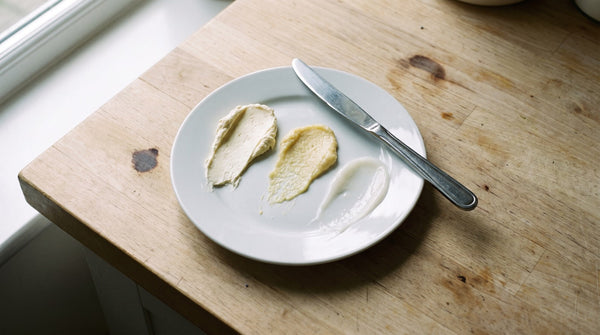
Tallow is rendered fat — usually from the suet, the firm fat around a cow's kidneys. Rendering means gently melting it, filtering out the protein and connective tissue, and letting the pure fat set. What's left is a solid, ivory-coloured fat that is shelf-stable for months without preservatives.
That's it. No emulsifiers, no water phase, no chemistry. Which is precisely why it was in every household until the 1950s, and precisely why the modern minimalist-skincare movement went looking for it again.
Cosmetic-grade tallow differs from the block in a butcher's freezer in three ways: the source animal (grass-fed matters, more on that below), how thoroughly it was deodorised during rendering, and how it was whipped or blended afterwards. A well-made tallow balm has no smell to speak of. A badly rendered one smells faintly of a roasting tin, and no amount of essential oil hides it.

The sebum argument, examined properly
The claim you'll see everywhere is that tallow is "biologically similar to human skin". That's a simplification, but it isn't nonsense — and it's worth understanding what's actually being said.
Skin produces sebum, an oily film that keeps water in and keeps the outer layer flexible. Sebum is built largely from fatty acids. Tallow is also built largely from fatty acids. The overlap is real, though not perfect:
| Fatty acid | Beef tallow | Human sebum | What it does |
|---|---|---|---|
| Oleic acid | ~40–50% | present, high | Softens, spreads, carries other lipids into the outer layer |
| Palmitic acid | ~24–28% | present, high | Structural; part of the skin's own barrier lipids |
| Stearic acid | ~18–22% | present, low | Gives the balm its firm, waxy set; sits on the surface |
| Palmitoleic acid | ~2–4% | notably present | One of the few plant-scarce acids skin makes itself; declines with age |
The practically useful part of that table is the last row. Palmitoleic acid is abundant in human sebum and rare in plant butters. It also drops off measurably as we get older, which is one plausible reason tallow tends to feel more "at home" on mature, dry skin than on a twenty-year-old's.
What the similarity does not mean: that tallow is absorbed and rebuilt into your own sebum, or that it replaces what your skin stopped producing. It sits in and on the outer layer, slows water loss, and softens. That is a real and useful job. It is not a transplant.
What tallow does well
1. It holds water in, hard
Tallow is highly occlusive — it forms a physical barrier that slows transepidermal water loss. For skin that is dry because it leaks moisture rather than because it lacks it, this is the single most effective thing you can do, and it is why a thin layer at night often outperforms a much more expensive serum.
2. It softens without a water phase
Most creams are mostly water held in suspension by emulsifiers. Tallow needs neither. For people whose skin reacts to emulsifiers, preservatives or fragrance, a short ingredient list is not marketing — it is the whole point.
3. It carries fat-soluble vitamins
Grass-fed tallow naturally contains vitamins A, D, E and K. This is true, and it's also the claim most often oversold. The quantities are small, and topical vitamin A from tallow is not comparable to a retinoid. Treat it as a small bonus of a well-sourced raw material, not as the reason to buy.
4. It suits winter, wind and washing
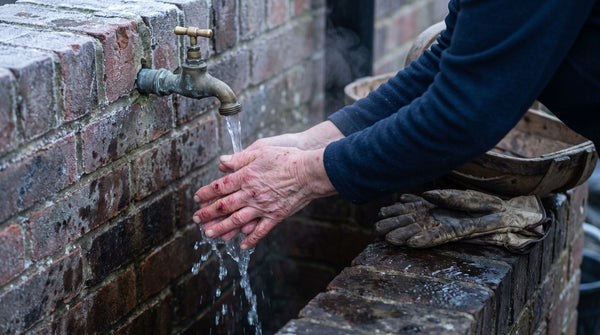
Cracked hands, wind-burnt cheeks, the tight feeling after a hot shower, the patch under the nose after a cold — this is where tallow is at its most obviously good, and where people who don't otherwise think about skincare become converts.

What tallow does not do
An honest guide has to include this section, and most don't.
- It does not stimulate collagen. There's no mechanism for it. If you want a firming effect, that's the job of peptides or a retinoid, not a fat.
- It does not fade pigmentation. Skin that is better hydrated looks more even, which is not the same thing as pigment being reduced.
- It offers no meaningful sun protection. No oil or balm does. Sunscreen stays.
- It is not a treatment for a skin condition. It may make dry, irritated skin more comfortable. Eczema, psoriasis and rosacea are medical matters — see a doctor, and use the balm alongside what they prescribe, not instead of it.
- It is not automatically better because it is natural. Poorly rendered tallow from a badly kept animal is worse than a well-made synthetic cream. Sourcing is everything.
Grass-fed vs grain-fed: does it matter?
Yes, but not for the reason usually given. The fatty acid profile of grass-fed tallow is somewhat more favourable — a better omega-3 to omega-6 balance and a higher fat-soluble vitamin content, because the animal ate green plants rather than grain. The differences are real but modest.
The bigger reason to care is what surrounds the fat. Fat is where an animal stores what it accumulates over its life. A pasture-raised animal that has not spent its life in a feedlot yields a cleaner raw material, and a producer who can tell you where it came from is usually also a producer who renders carefully and filters properly.
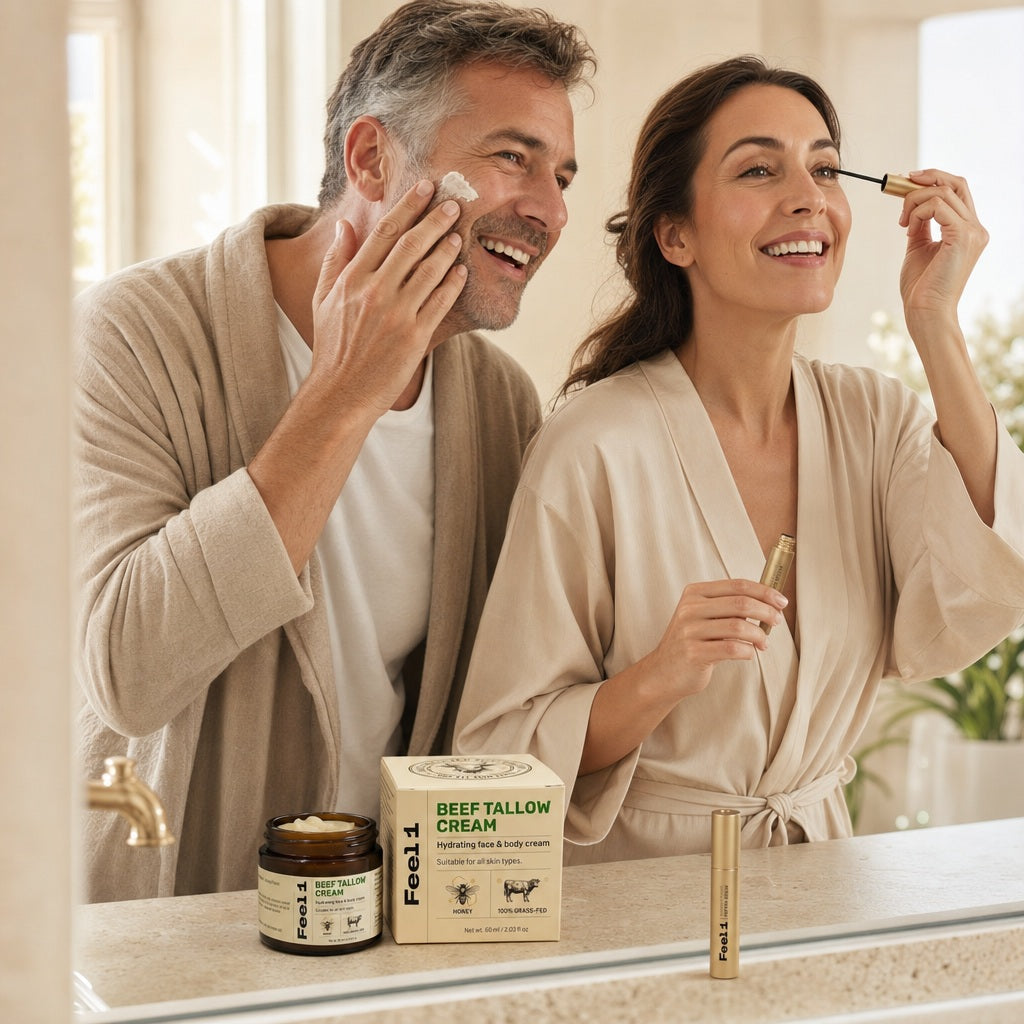
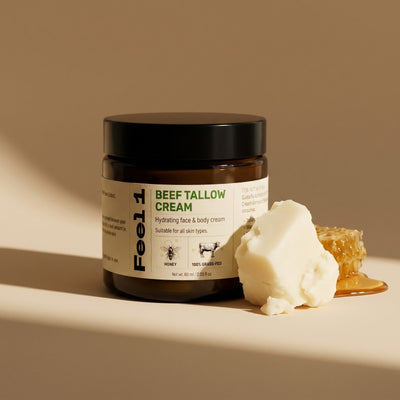
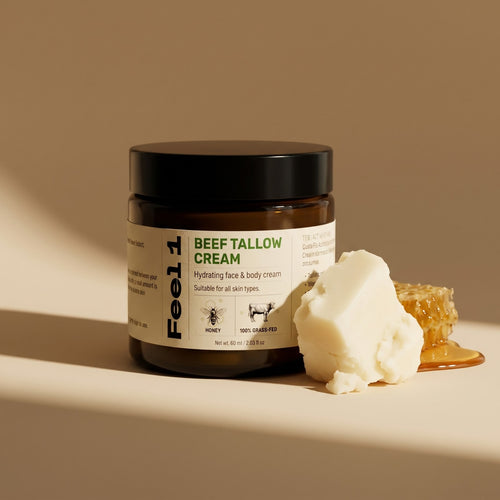
The Feel1 Beef Tallow Cream is built on 100% grass-fed tallow blended with honey, for exactly that reason: the raw material is the formula.

Who it suits — and who should be careful
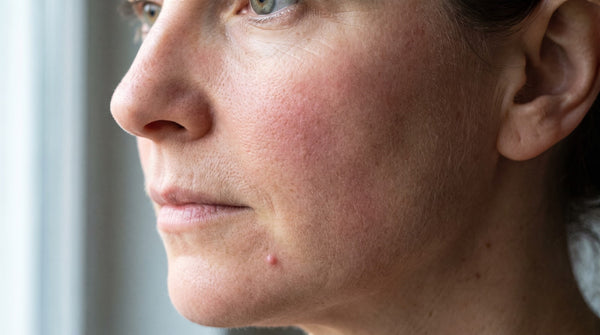
A good fit: dry to very dry skin; mature skin, especially after menopause when sebum production falls; sensitised skin that reacts to long ingredient lists; anyone with cracked hands, elbows or heels; skin recovering from over-exfoliation or a harsh retinoid start.
Go carefully: if your skin is oily and congestion-prone. Tallow is high in oleic acid, and oleic-rich fats sit heavily on skin that already produces plenty of its own. That doesn't mean it will break you out — the picture is more nuanced than the internet suggests, and we've written the full version in Does beef tallow clog pores? — but it does mean you should start on a small area and use far less than you think.
How to actually use it
- Use a fraction of what looks right. A rice-grain amount covers a whole face. Tallow is dense; if your skin looks greasy after ten minutes, you used three times too much.
- Apply to damp skin. Straight after cleansing, while the face is still slightly wet. An occlusive works by trapping water — give it water to trap.
- Warm it first. Press it between your fingertips for a few seconds until it turns from a solid to an oil, then press it into the skin rather than rubbing.
- Last step, always. Nothing penetrates a layer of fat. Serums and treatments go on first; the balm seals the lot.
- Start at night. Give it two weeks as a night treatment before you decide whether it works under makeup. Most people end up using it at night only, and that's a perfectly good outcome.

Five mistakes that make people give up too early
Using it like a lotion. Slathering a dense balm on dry skin gives you a greasy film and no benefit. Less, on damp skin.
Judging it in three days. Barrier repair runs on skin-cell turnover, which takes roughly four weeks in your forties and longer after that. Two weeks is the earliest sensible checkpoint.
Putting it under a heavy foundation. Most foundations are not designed to sit on a fat layer and will separate. Night use avoids the argument entirely.
Buying an unfiltered, unsourced jar. If the seller can't tell you the animal's diet and how it was rendered, that's the answer.
Expecting it to do a treatment's job. Tallow is the sealing step. If you also want firming or brightening, that comes from what goes on underneath it.
Frequently asked
Does beef tallow smell like beef?
Properly rendered and deodorised tallow has almost no scent — a faint, neutral warmth at most. If a product smells of cooking, it was rendered badly.
Is it vegan or vegetarian?
No. Tallow is an animal fat, and there is no honest way around that. If that rules it out for you, a shea- or squalane-based balm is the closest functional substitute, though neither contains palmitoleic acid.
Can I use it around my eyes?
Yes, in a very small amount, and press rather than rub. Some people find any occlusive causes morning puffiness in that area — if that's you, keep it to the cheekbone and outwards.
Can I use it with retinol or acids?
Yes, and it's one of tallow's better uses. Treatment first on clean skin, wait a few minutes, then the balm on top. It softens the dryness of a retinoid ramp-up without cancelling it out.
How long does a jar last?
Used correctly — a rice-grain per application — a 60 ml jar lasts a face two to three months. Unopened, tallow is stable for a year or more; once opened, keep it out of direct sun and use clean fingers.
The short version
Beef tallow is a very good occlusive emollient with a fatty acid profile that happens to overlap unusually well with what human skin makes — most usefully for skin that has stopped making enough of its own. It seals, softens and calms. It does not firm, brighten or treat disease, and any seller telling you otherwise is telling you something they can't support.
Judged as what it is rather than what it's marketed as, it's one of the most reliable things you can put on dry skin.