




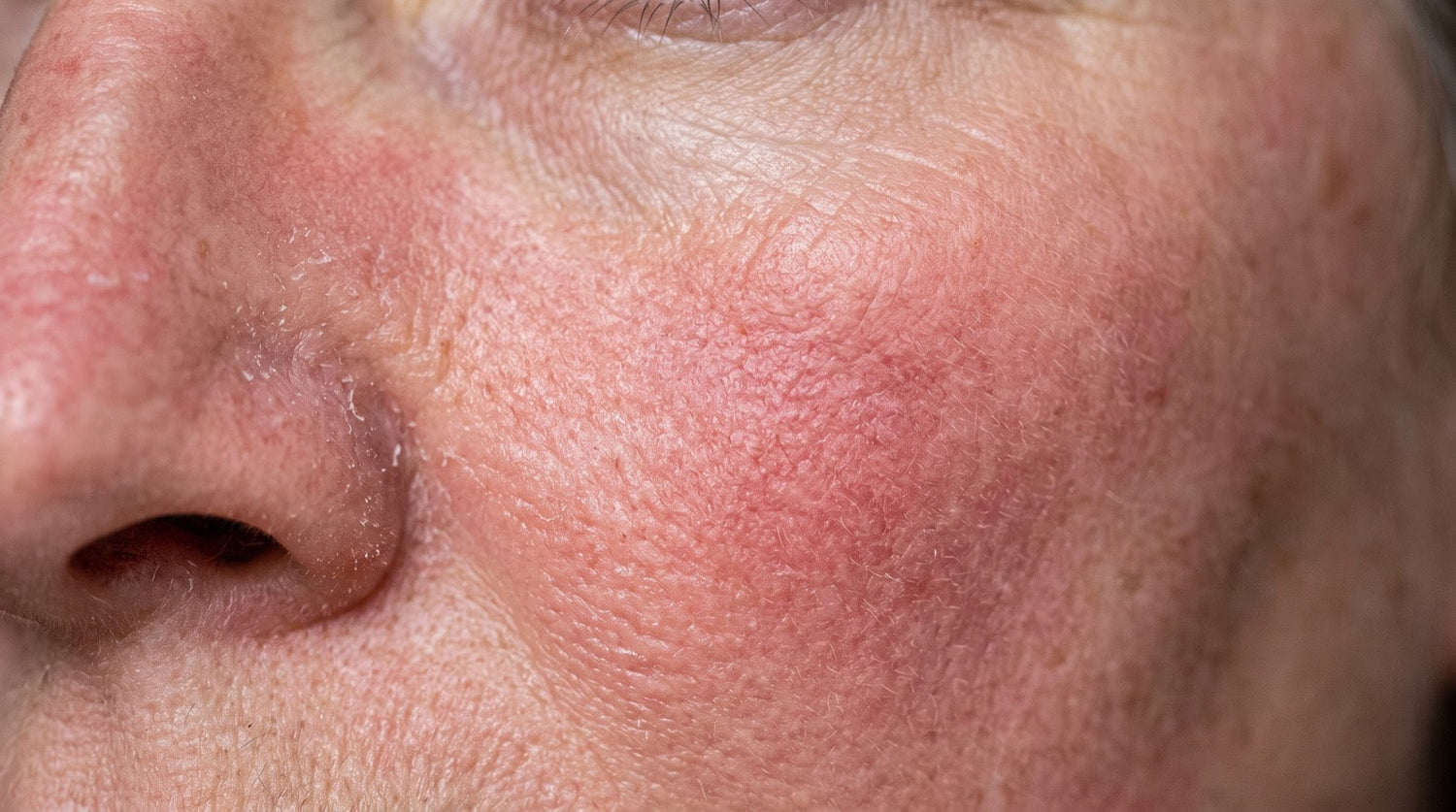
If your skin stings when you apply things it used to tolerate, that is not sensitivity you were born with. It is a barrier you have broken, and it repairs in about a fortnight if you let it.
Almost everyone who describes themselves as having "suddenly sensitive skin" has an impaired barrier rather than a new allergy. The distinction matters, because one is a permanent trait and the other is a fixable state that most people fix by doing less.
What the barrier actually is
The outermost layer of skin is often described as brickwork: flattened dead cells as the bricks, a lipid mortar holding them together. That mortar is roughly half ceramides, with cholesterol and free fatty acids making up the rest, and the ratio between the three matters as much as the amounts.
Its job is to keep water in and irritants out. Damage it and both directions fail at once: water leaves faster than it can be replaced, and things that would normally sit harmlessly on the surface reach nerve endings and immune cells that were never meant to meet them.
That is why the two headline symptoms are dryness and stinging, and why they arrive together.
The six signs
1. Products that used to be fine now sting
The single most reliable sign. A vitamin C serum you have used for two years starts burning; a moisturiser tingles. The product did not change.
2. Tightness immediately after washing
Healthy skin feels comfortable within a minute of being dried. Barrier-damaged skin feels tight and stays tight until something is applied.
3. Redness that lingers
Diffuse pinkness across the cheeks and around the nose that does not settle within an hour of washing, or a flush that appears from a temperature change and stays.
4. Flaking alongside oiliness
Counter-intuitive but common. The skin senses water loss and overproduces oil to compensate, while the surface is still shedding. Flakes on a shiny face are a barrier signal, not a skin type.
5. Rough or bumpy texture
Small closed bumps, particularly on the cheeks and forehead, that are not spots. Disordered shedding rather than blocked pores.
6. Everything you add makes it worse
The most telling one. Each new product to fix the problem produces a new reaction, and the instinct is to try another. That loop is the diagnosis.

What usually causes it
- Over-exfoliation — by far the most common. An acid toner plus a scrub plus an exfoliating cleanser is three, and each one alone might have been fine.
- Starting a retinoid too fast — nightly from day one instead of twice a week.
- Foaming cleansers twice a day on skin that no longer produces much oil.
- Hot water, in the shower and at the sink.
- Winter air — indoor humidity at 20 to 30% pulls water out faster than skin replaces it. More on that in winter skin.
- Age — ceramide production falls, so the same routine that was survivable at thirty is not at fifty-five.

The two-week repair
This works, it is free, and the hardest part is the discipline of subtracting.
Days 1–14: strip the routine back
- Stop every active. All acids, all retinoids, all vitamin C, all exfoliation. Not reduce — stop.
- One gentle cleanse a day, in the evening. Lukewarm water only in the morning.
- A bland moisturiser on damp skin, morning and night.
- An occlusive on top, especially at night. This is what actually does the repairing — it holds the water in while the lipids rebuild.
- Sunscreen, mineral if the chemical filters are stinging.
- Nothing else. No masks, no new products, no "gentle" exfoliant, no facial.
Most people feel a difference within three days and look better within ten. Full lipid turnover takes around two to four weeks depending on your age.
Weeks 3–4: rebuild carefully
Add one thing. Wait a week. If it is comfortable, add the next. Anything that stings on healthy skin does not belong in your routine at all.

What to use while it repairs
Short ingredient lists, no fragrance, no essential oils, no denatured alcohol high in the list. Ceramides if you have them. An anhydrous balm is particularly useful here because there is no water phase, no emulsifier and no preservative to react to — one of the few times a very simple product genuinely outperforms a sophisticated one.
Soothing rather than active is the aim: PDRN, panthenol, glycerin, niacinamide at a low percentage. Nothing that asks the skin to do work.
When it is not just the barrier
See a doctor if there is a defined rash with borders, weeping or crusting, if it does not improve at all after two weeks of the routine above, if it is spreading, or if it started with a new medication. Rosacea, perioral dermatitis and contact allergy all look like barrier damage at first and none of them resolve by doing less.
Frequently asked
How long does a damaged skin barrier take to heal?
Comfort improves within days. Visible repair takes two to four weeks, longer over fifty as cell turnover slows.
Can I use a retinoid again afterwards?
Yes, once the skin is comfortable — twice a week, buffered under moisturiser, building slowly. Most barrier damage from retinoids comes from starting too fast, not from the ingredient.
Is "skin purging" the same thing?
No. Purging is an accelerated shedding of existing microcomedones caused by something that speeds turnover, and it resolves in four to six weeks. Barrier damage is stinging and redness, and it gets worse the longer you push on.
Do I need a special barrier repair cream?
Not necessarily. A well-formulated ceramide cream helps, but so does a plain occlusive over a bland moisturiser. What matters far more is what you stop using.