



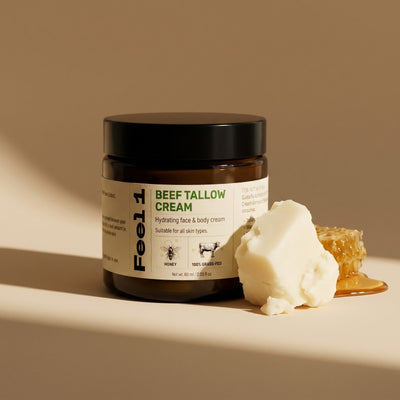

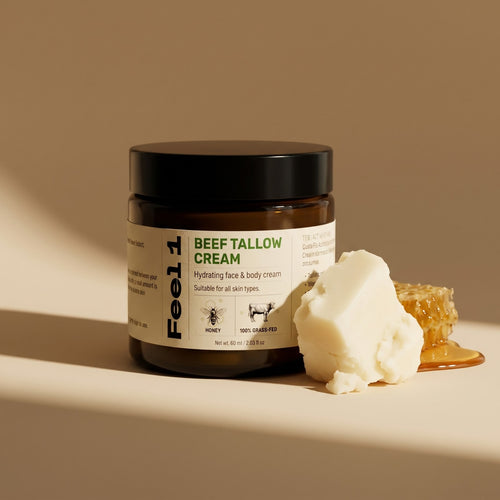

Making it yourself is genuinely doable, costs very little, and teaches you more about tallow than any article. Here is the method — and an honest account of where home rendering falls short.
Half the people searching for this want to make it. The other half want to understand what they are buying. This covers both: the full method, and the three things a home kitchen cannot easily do.
What you need
- Beef suet — the hard fat from around the kidneys, ideally grass-fed. A butcher will usually sell it cheaply or give it away. Ask for "suet", not "trimmings"; trimmings render into a softer, more strongly scented fat.
- A heavy pan or slow cooker
- A fine sieve and muslin or a coffee filter
- Clean glass jars
- An electric hand mixer, for the whipping stage
- Optional: a spoon of a liquid oil (jojoba or olive) to soften the final texture
Step 1: Render
- Trim and chop. Remove any meat or blood — these are what make tallow smell. Cut into small cubes, or ask the butcher to mince it, which speeds everything up.
- Melt low and slow. A slow cooker on low, or the lowest hob setting, for four to six hours. Add a splash of water at the start if you are using a pan; it prevents scorching and evaporates off. Do not let it brown — browning is where the cooking smell comes from.
- Strain. Pour the liquid fat through a sieve lined with muslin. Then strain a second time. The second pass is what separates a neutral balm from one that smells faintly of a roasting tin.
- Set. Pour into a wide jar and leave at room temperature until solid and ivory white.
Roughly 1 kg of suet yields around 700 to 800 g of tallow.

Step 2: Whip
- Soften, do not melt. The tallow should be the consistency of cold butter. If it has fully melted, let it set again — whipping liquid fat produces a grainy result.
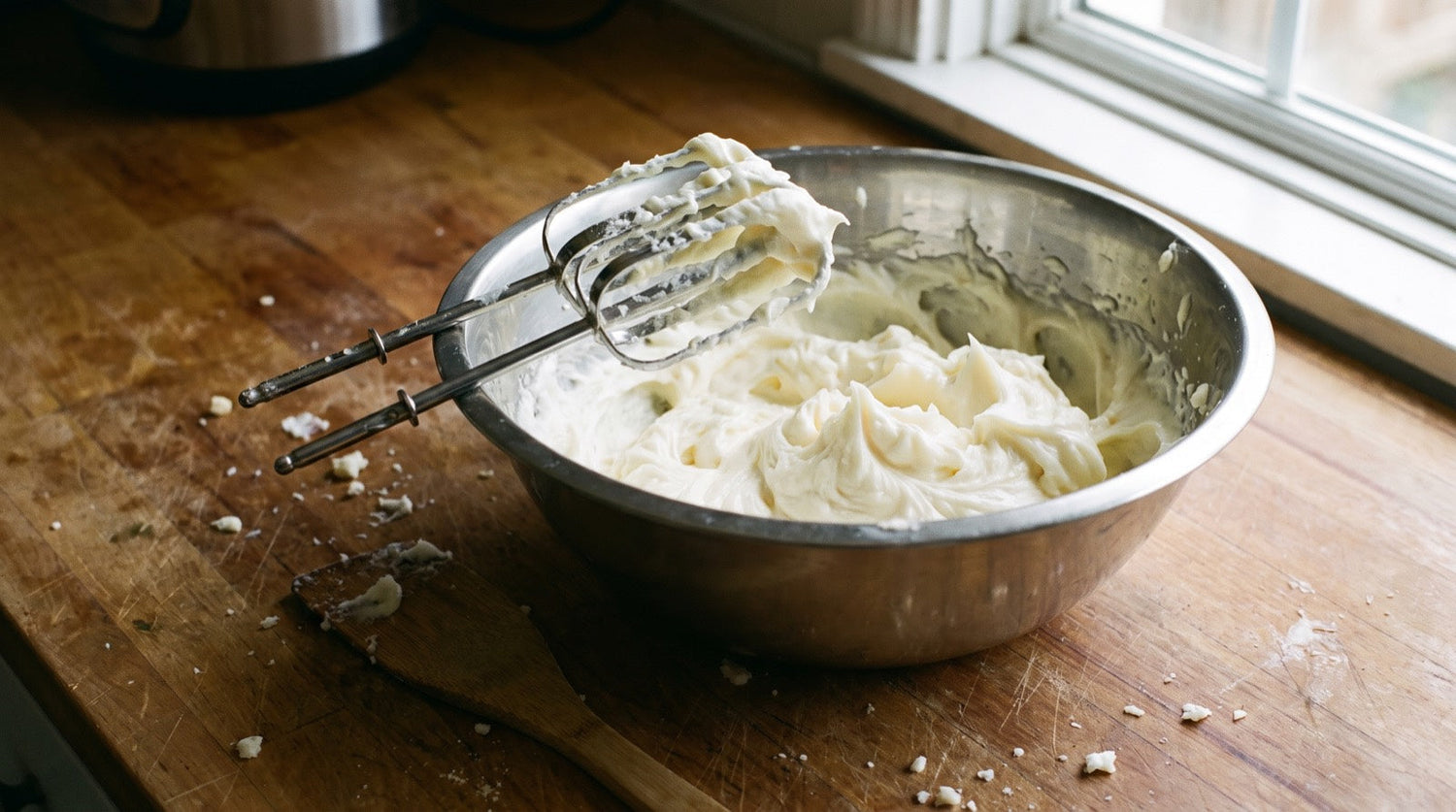
- Beat for five to eight minutes, scraping down the sides. It goes from dense and yellowish to pale, light and matte.
- Add a spoon of liquid oil partway through if you want a softer finish, no more than 10% by weight.
- Jar it and leave the lid off for an hour before sealing, so any condensation escapes.
Store somewhere cool and dark, use clean fingers or a small spatula, and expect it to keep six to twelve months. Water is the enemy — a wet finger in the jar is how a batch spoils.

Where home rendering falls short
This is the part most recipe posts leave out, and it is the honest reason a good bought balm costs what it does.
1. Deodorising is hard without equipment
Commercial processing removes volatile odour compounds through repeated washing and filtration under controlled conditions. At home you can get close with careful low-temperature rendering and double straining, but many home batches carry a faint beefy note that becomes obvious on your own face.
2. You cannot verify the source
Fat is where an animal stores what it accumulates. "Grass-fed" from a supermarket butcher counter is a claim about the meat, not necessarily a traceable claim about the suet. If sourcing is the reason you are interested in tallow, home rendering does not automatically solve it.
3. No preservative system, no stability testing
Pure tallow is shelf-stable because it contains no water. The moment you add anything water-based — aloe, hydrosol, honey that has not been properly incorporated — you have created a medium for bacteria with nothing to control it. Most home recipes that go wrong go wrong here.
The practical rule: keep it anhydrous. Fat and oil only.
Three mistakes worth avoiding
Rendering too hot. Browning is irreversible and you will smell it every time you use it. Low and slow, always.
Straining once. The second pass through muslin is what removes the fine protein particles that both smell and shorten shelf life.
Adding essential oils generously. Undiluted essential oils on facial skin are a common cause of contact dermatitis. If you must, keep total essential oil below 0.5% — and if you are adding them to cover a smell, fix the rendering instead.

Is it worth making?
If you enjoy the process, want a body balm, and have a good butcher — yes, easily. The economics are excellent and the result is perfectly good for hands, elbows and shins.
For the face, the calculation is different. Facial skin is less forgiving about scent and about the small amount of residual protein that home straining leaves behind, and that is precisely what commercial processing is for. Plenty of people render for the body and buy for the face, which is a perfectly sensible arrangement.
Either way, you will understand the ingredient better for having made a batch — and our full guide on what tallow actually does on skin will make a good deal more sense afterwards.
Frequently asked
Can I use suet from the supermarket?
Packaged shredded suet usually contains flour or a stabiliser and is not suitable. You want raw block suet from a butcher.
Why did my balm turn out grainy?
It cooled unevenly, or you whipped it while it was too warm. Melt it fully again, let it set at a steady cool room temperature, and re-whip.
How long does home-made tallow balm keep?
Six to twelve months kept cool, dark and dry. If it smells sharp or crayon-like, it has oxidised — start again.
Can I add water-based ingredients?
Not without a preservative and the knowledge to use one properly. Keep home batches anhydrous.