







Thirty years of plucking leaves a mark. Some of it grows back, some of it does not — and knowing which is which saves a lot of wasted months.
If you were a teenager in the nineties, you were sold a thin brow, and you spent a decade delivering it. The bill arrives later: a tail that never quite fills in, gaps in the arch, and short hairs that grow at odd angles and stop.
This is what is recoverable, what is not, and how long the honest version takes.
What repeated plucking actually does
Pulling a hair out removes the shaft and the bulb, but usually not the follicle itself. The follicle is a structure in the skin, and it can produce again — that is why a brow plucked once grows back within weeks.
The problem is repetition. Each extraction is a small trauma. Do it every fortnight for twenty years and two things happen: the follicle can shrink to producing a finer, shorter, lighter hair each cycle, a process called miniaturisation, and some follicles scar over and stop entirely.
So the honest picture is a spectrum. Some follicles are dormant and will produce again given time. Some are miniaturised and will produce something finer than they used to. Some are gone, and nothing topical brings them back.
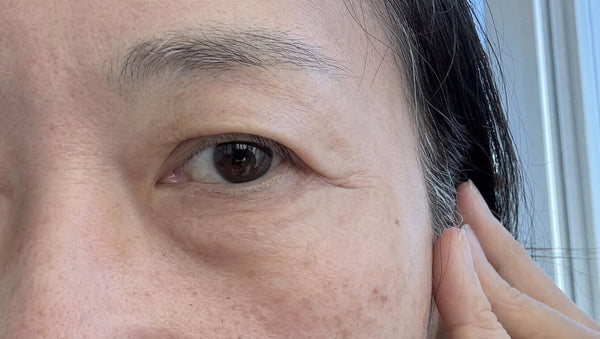
The useful test: stop plucking entirely and look closely in daylight after three months. Fine, pale, short hairs appearing in the gaps mean live follicles — that is your regrowth potential. Perfectly smooth skin with no hair at all means those follicles are done.

The brow growth cycle is slower than you think
Brow hairs have a much shorter growth phase than scalp hair — around 30 to 45 days — followed by a rest that can run for several months. That is why they stay short, and it is also why the sequence takes so long.
| Weeks 1–4 | Nothing. Existing hairs may look slightly better conditioned. Almost everyone quits here. |
| Weeks 6–10 | First fine new hairs appear in gaps, often pale and easy to miss. Look in daylight, not bathroom light. |
| Months 3–4 | New hairs darken and lengthen. The shape starts to change. |
| Months 4–6 | As full as this brow is going to get. What is not back by now is not coming back. |

The rules, in order of importance
1. Stop plucking. Completely.
Not "just the strays". Not "just under the arch". Every extraction resets a follicle to the start of a cycle it may not complete. Six months of nothing is the price of finding out what you still have.
The practical trick is to remove the tools from the bathroom entirely and put the magnifying mirror away. Almost nobody plucks without a magnifying mirror.
2. Brush them daily
A spoolie brush, upwards and outwards, morning and night. It lifts hairs that grow flat, stimulates the area, and makes existing hair cover more ground immediately. It is the fastest visible improvement on this list and it costs nothing.
3. Feed the skin they grow out of
Brow skin over fifty is drier and thinner. A little of whatever you already use, pressed along the brow bone, keeps the area from getting flaky and tight. Not a growth treatment — a decent growing environment.
4. A peptide serum, applied to the skin
Peptides support keratin production and follicle anchoring, so the hairs a live follicle produces are less likely to break off at three millimetres. Apply along the brow with a fine brush, into the skin, not onto the hairs. Same eight-to-twelve week timeline as lashes.
Avoid the prostaglandin serums here for the same reasons as on lashes — plus one specific to brows: they can darken the surrounding skin, which on a brow is unusually visible. The details are in lash serums without prostaglandins.
5. Rule out the medical causes
If the outer third of both brows has thinned — the classic pattern — get your thyroid checked before you buy anything. Iron deficiency and alopecia areata also show up here. This is not a rare finding, and treating it works better than any serum.

Filling in while you wait
Six months is a long time to look at a gap. Two things that help without interfering:
Pencil, not powder, in short upward strokes that imitate individual hairs. Powder fills the space between hairs and reads as a block; strokes read as brow.
One shade lighter than you think. Brows darker than your hair look drawn on, and the contrast draws attention to exactly the gaps you are covering.
What about microblading?
It is a reasonable option for follicles that are genuinely gone, and a poor one if you have not yet found out. Pigment is deposited into the skin, it lasts a year or two, and it does not stop hair growing.
The order matters though: do the six months of nothing first, see what comes back, then decide what actually needs filling. Microblading a brow that would have regrown is an expensive way to solve a problem you did not have.
Frequently asked
Can eyebrows grow back after twenty years of plucking?
Partly. Dormant follicles can restart, miniaturised ones produce finer hair, and scarred ones do not return. Most people get a meaningful improvement, not the brow they had at fifteen.
Does castor oil grow eyebrows?
It conditions the hairs you have and reduces breakage. There is no evidence it stimulates follicles. It is also heavy enough to cause irritation on the brow line for some people.
How long before I can tidy the strays?
Six months, ideally. If that is unbearable, trim with small scissors rather than pluck — a trimmed hair keeps its follicle in the cycle.
Why do some new brow hairs grow straight up or sideways?
Repeated trauma can change the angle at which a follicle sits. Daily brushing trains them; a clear brow gel holds them.