





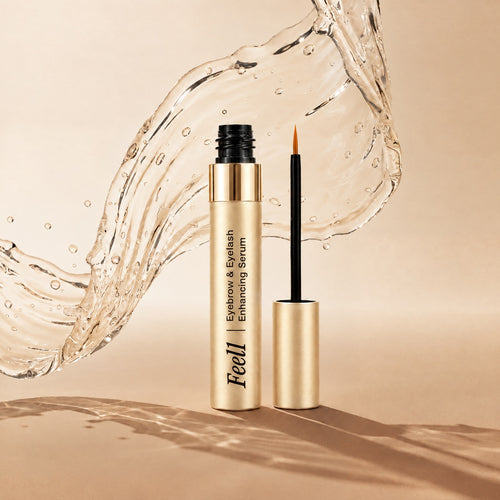

Most lash serums that visibly work contain a prostaglandin analogue — a glaucoma drug repurposed for cosmetics. Here is what that does, why it is worth avoiding, and what actually works instead.
If you have ever searched for a lash serum and come away confused, this is why: two completely different categories of product sit under the same name. One borrows a prescription eye medication. The other uses peptides. They produce different results, on different timescales, with very different side-effect profiles — and the labels rarely make the distinction clear.
How the prostaglandin serums came about
In the 1990s, ophthalmologists prescribing latanoprost for glaucoma noticed something odd in their follow-ups. The drug lowered eye pressure as intended, but patients kept coming back with longer, darker, thicker lashes. It was an unwanted side effect of a serious medication — and a commercial idea waiting to happen.
Prostaglandin analogues work by extending the anagen phase, the active growth stage of the hair cycle. Lashes normally grow for around 30 to 45 days before resting and shedding. Hold them in growth longer and they simply get longer. The effect is real, it is well documented, and it is the reason those products have such striking before-and-after photos.
The catch is that the mechanism does not confine itself to lash length.
The side effects nobody mentions at the point of sale
Iris pigmentation change
Prostaglandin analogues can increase melanin production in the iris. In glaucoma patients receiving drops directly into the eye, this is a documented and permanent effect — hazel or green eyes darkening towards brown. Topical lash application delivers far less drug and the risk is correspondingly lower, but it is not zero, and it does not reverse.
Darkening of the eyelid skin
The same pigment effect on the lid itself, usually appearing as a grey-brown shadow along the lash line. This one is common, and it does typically fade over months once you stop — which is little comfort if you started the serum to look more awake.
Periorbital fat atrophy
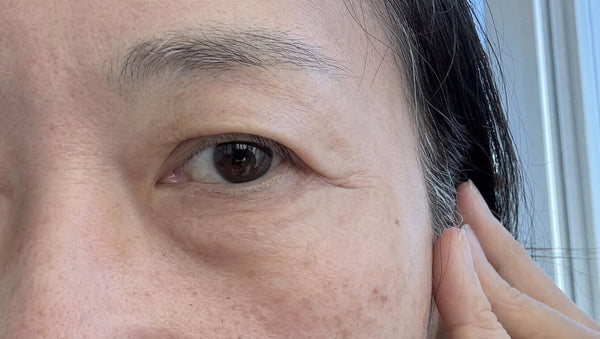
The one that gets discussed least and matters most. Prostaglandin analogues are associated with loss of orbital fat, producing a hollowed, sunken look around the eye. In glaucoma literature it has a name: prostaglandin-associated periorbitopathy. It is partially reversible in some people and not in others.
For a woman in her fifties who started a serum because the area was already looking tired, trading fuller lashes for a more hollowed eye socket is a poor exchange.
Redness and irritation
The most common complaint by far, and the reason a lot of people quietly stop after a few weeks.
How to tell what is in the bottle
Look for these on the ingredient list. If any appear, you are holding a prostaglandin-analogue product, whatever the front of the box says:
- Isopropyl cloprostenate — by far the most common in cosmetic serums
- Bimatoprost — the prescription version, brand name Latisse
- Dechloro dihydroxy difluoro ethylcloprostenolamide — a deliberately unpronounceable relative
- Latanoprost, travoprost, tafluprost — the ophthalmic drugs themselves
- Anything ending in -prost or -prostenate
Marketing language is not a reliable guide. "Clinically proven", "dermatologist tested" and "hormone free" all sit comfortably on a bottle of isopropyl cloprostenate. Only the ingredient list tells you.

What peptide serums do instead
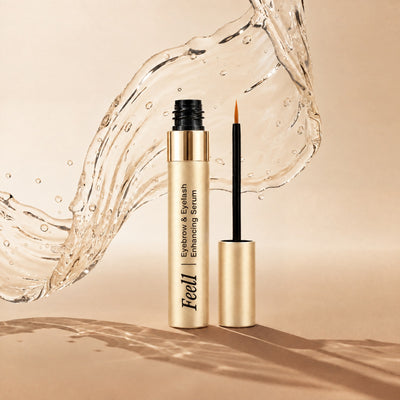
Peptides are short chains of amino acids that act as signals rather than drugs. In lash products the ones you will see most often are myristoyl pentapeptide-17 and myristoyl hexapeptide-16, usually alongside biotin, panthenol and amino acids.
Rather than forcing the growth phase to continue, they support the follicle's own conditions: keratin production, follicle anchoring, and the strength of the hair shaft so that lashes reach their natural full length instead of breaking off partway. The realistic outcome is lashes that look denser and darker because fewer of them are snapping, plus a modest gain in length.
The honest comparison: a prostaglandin serum produces a bigger visible change, faster. A peptide serum produces a smaller change, more slowly, without touching iris pigment, lid colour or orbital fat. Which trade you want is a personal decision — but it should be an informed one, and most people are never told there is a trade at all.

What to expect from a peptide serum
| Weeks 1–3 | Nothing visible. Lashes feel slightly more conditioned. This is where most people give up too early. |
| Weeks 4–6 | Less breakage. Fewer lashes on the cotton pad at night — the first real signal that it is working. |
| Weeks 8–12 | Visible density. The lash line looks fuller because more lashes are surviving to full length. |
| Beyond | Maintenance. Stop, and you drift back to baseline over roughly two to three months as the cycle turns over. |

How to apply it properly
- Clean, completely dry lids. Any residue of oil or makeup remover blocks contact with the lash line.
- One thin stroke along the upper lash line, as if drawing a fine eyeliner. Not on the lashes themselves — the follicle is in the skin.
- Upper lid only. The lower lash line is where product migrates into the eye, and it adds little.
- Once a night is enough. Twice does not double anything and raises the chance of irritation.
- Contact lenses out first, back in the morning.
- Eight weeks before judging. Photograph your lash line on day one in daylight, same angle, and compare.
If you are coming off a prostaglandin serum
Stop it and expect to lose the extra length over two to three months — that is the growth cycle returning to normal, not damage. Lid darkening usually fades over a similar period. Start a peptide serum straight away if you like; there is no washout period needed, and it will soften the drop-off.
If you have noticed any hollowing around the eye or a change in iris colour, see an ophthalmologist rather than an article.
Frequently asked
Do peptide lash serums really work, or is that just marketing?
They work in a narrower way than the prostaglandin products, and the honest claim is fewer broken lashes and better density rather than dramatic new length. Anyone showing you a peptide serum with prostaglandin-style results is showing you something else.
Can I use one with lash extensions?
Yes, and it is a sensible thing to do — extensions place constant weight on the natural lash. Apply it at the lash line, not through the extensions, and check with your technician which adhesive they use.
Will it work on my brows?
The same mechanism applies to brow hair, and a serum with a fine brush is easy to run along a sparse brow. Expect the same timeline.
Is it safe if I have sensitive eyes?
Peptide formulas are far gentler than the alternative, but the eye area is the eye area. Patch test on the inner forearm for two days, then start every other night for the first fortnight.