




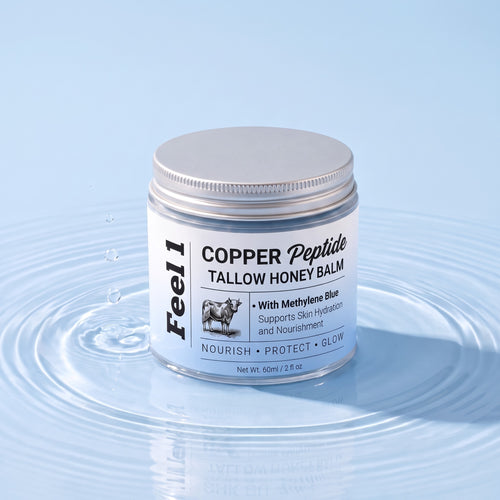
Short answer: don't apply them in the same layer, at the same moment. Use vitamin C in the morning and copper peptides at night, and you get the benefit of both with none of the argument. You do not need to give either one up.
This is one of the most-repeated warnings in skincare, and one of the most exaggerated. The usual version — "copper peptides and vitamin C cancel each other out" — is stated with far more confidence than the underlying chemistry justifies, and it has put a lot of people off a perfectly workable combination.
Here's what's actually going on, and what to do about it.
The chemistry, briefly
Two separate things are described, and they get muddled together.
1. Copper is a redox-active metal. In the presence of a strong reducing agent like L-ascorbic acid — pure vitamin C — copper ions can participate in reactions that generate free radicals. This is well-established chemistry. It is also the reason a copper peptide binds its copper: the peptide holds the ion in a stable complex specifically so it doesn't behave like loose copper.
2. pH. L-ascorbic acid needs a low pH, typically around 3.5 or below, to stay stable and penetrate. Peptides generally prefer something closer to neutral. Put them together and one of them is in the wrong environment — usually the peptide.
Neither of these means the two ingredients destroy each other on contact. What they mean is that mixing them in a single layer risks getting less out of both, and, in the worst case, some pro-oxidant activity you didn't want. That's a reason to separate them, not a reason to fear them.
What to do instead
| When | What | Why |
|---|---|---|
| Morning | Vitamin C, then moisturiser, then sunscreen | Vitamin C's antioxidant work is most useful during daylight exposure |
| Evening | Copper peptides, then moisturiser or balm | Repair-oriented ingredients suit overnight, and the two never meet |
That's the whole solution. If you'd rather use both in the evening, leave at least twenty to thirty minutes between them so the first has absorbed and the skin's pH has recovered — but morning and night is simpler and works better.

Does the form of vitamin C change things?
Yes, and this is the nuance most warnings leave out.
- L-ascorbic acid — the potent, low-pH, unstable form. This is the one the warning is really about. Separate it.
- Sodium ascorbyl phosphate, magnesium ascorbyl phosphate, ethyl ascorbic acid, ascorbyl glucoside — derivatives that work at higher pH and are far less aggressively reducing. The conflict largely disappears with these, though separating them still costs you nothing.
- Tetrahexyldecyl ascorbate — an oil-soluble derivative in a completely different environment. Not a practical concern.
If your vitamin C product is a light serum at pH 3 that turns orange in three months, treat it as L-ascorbic acid and separate. If it's a stable cream that never changes colour, you're almost certainly using a derivative and can relax.
What else not to layer with copper peptides
The same principle — separate by time, don't abandon — applies to a short list:
- Direct acids (AHA, BHA). The low pH is the issue, same as with L-ascorbic acid. Acids one night, peptides the next.
- Benzoyl peroxide. A strong oxidiser; keep it well away in time and place.
- Retinoids. Not a chemical conflict at all — just a tolerance one. Both on the same night is a lot for most barriers. Alternate.
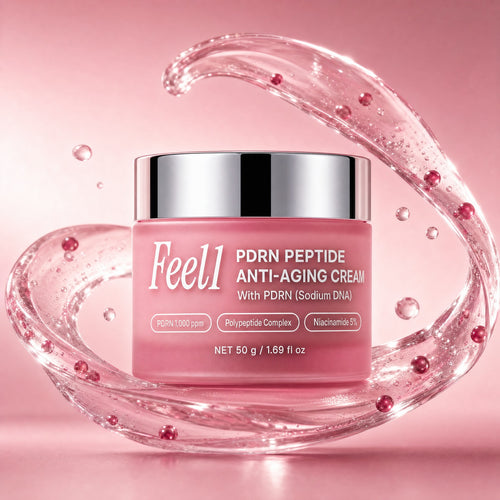
And a list of things that are fine together, because this ingredient attracts more caution than it deserves: niacinamide, hyaluronic acid, ceramides, PDRN, other peptides, and any occlusive balm on top.

Is the warning overblown?
Partly, yes. Most of what circulates online traces back to in-vitro chemistry rather than to studies of finished products on human skin, and formulators have known about these interactions for decades — a well-built product accounts for them.
But the practical advice that comes out of it is sound and costs nothing: use vitamin C in the morning, copper peptides at night. You'd probably arrange your routine that way anyway.

Frequently asked
What if I've been using them together for months?
Nothing bad has happened to your skin. You've most likely been getting less from one or both. Split them and see whether anything improves over the next six weeks.
Can I use them in the same routine if one is a cream?
Better than mixing them, but the timing rule still applies. Let the first absorb fully — twenty minutes or so — before the second.
Does the same apply to copper peptides and niacinamide?
No. That pairing is fine, and the two are often formulated together.
Do I still need a moisturiser on top?
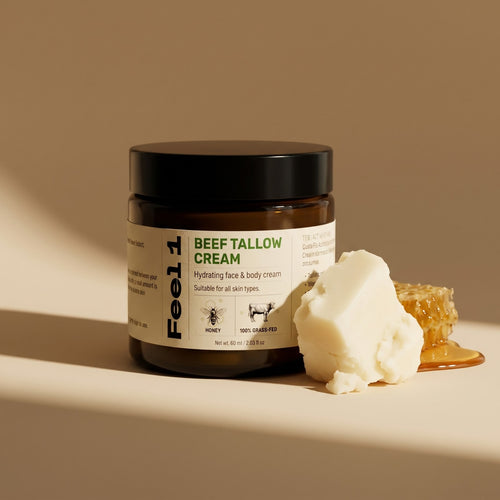
If your skin is dry, yes. A peptide layer sealed with an occlusive works better than either alone — a plain tallow balm over the peptide step is the simplest version of that.
Which should I use if I can only pick one?
Vitamin C if pigmentation and dullness are your concern, copper peptides if firmness and skin quality are. If it's both, that's exactly what a morning-and-night split is for.